1) That V. Which
- "The car that I was driving got a flat tire."
- "My son's car, which I was driving, got a flat tire."
- The distinction between restrictive and nonrestrictive adjective clauses affects the choice between that and which. In nonrestrictive adjective clauses, which is nearly always used now instead of that.
- Use only that in restrictive adjective clauses...we distinguish restrictive and nonrestrictive clauses in writing by putting commas around the nonrestrictive ones.
2) Lie V. Lay
- Rule of thumb: You lie around, but you lay something down.
Lie - conjugation:
Present tense: lie/lies
Past tense: lay
Past participle: lain
Present participle: lying
Lay = conjugation:
Present tense: lay/lays
Past tense: laid
Past participle: laid
Present participle: laying
- The past tense of lie and the present tense of lay are the same thing (i.e. lay)...this can create a lot of confusion.
Source: The McGraw-Hill Handbook of English Grammar and Usage, 2005.
Sunday, April 3, 2011

Monday, March 28, 2011

Saturday, March 26, 2011
"It's so easy to be a poet and so hard to be a man."
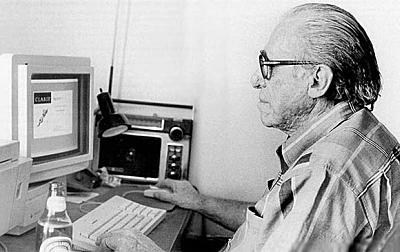
That was written by Charles Bukowski, pictured above. When people were saying in the early 90s that computers were "glorified typewriters", he was embracing the new movement...that was the impetus for me to use this photo. I'm not promoting his writing or his beliefs because I don't agree with all of them, but nevertheless it's important to discuss him.
I always wonder about authors like him, and how they would view me (and if I achieved success in my writing, how they would see me then).
I never starved, although life's been hard since I moved out by myself five years ago. I never had parents who didn't care about me - they give me money to help me live. I never absolutely had to work a deadening job in order to survive, although I've worked those jobs before. I've never had a delibitating illness or physical handicap. I've never had to go to war. I've never suffered a great loss (such as the death of someone very close to me, yet). I've never had to run for my life.
But I don't see myself as better than people who've gone through these misfortunes. And I don't try to hide myself from the misfortunes of the world. I've never wanted to live off of my parents for as long as I could, I wanted to live on my own terms and support myself...but money is addictive when I have little of it. And I never believed that I was special and the world needed to know - I've only known that I'm taking a path which few people take, and I'm using the talent I have to press through it. And does it really matter what they would think? Do I need to dwell on it? (Not really.)
Yet if they saw me as unwise and uninformed as a result of not going through what they've gone through, and as a result they didn't see me as capable of creating great literature...is that tolerable? Do I need to suffer like they've suffered? Will that allow me to write better? (No.)
A lot of soldiers want to write their life story. And they do, and they take it to a self-publishing company and have it released. They're proud of having written their story. Does the fact that they've been through the depression of war mean that their work automatically has more substance than my own (assuming their experience/position led them to experience the sickness war can hold)?
I don't think so, but some would say that it's true. And this is another part of the interior struggle I have to contend with, being on my own and having a passion for literature.
Bukowski's quote above disgusts me - I never want to become someone who writes like they mean it yet can't maintain a stable life outside of writing. Who just leeches off of everyone and doesn't sculpt their own place in the world, who can't support a family, who only thinks of himself, who doesn't believe in charity. And yet still he strives to write meaningful literature. Again the question of autonomy comes up.
The quote ties into a mantra of mine that I've been thinking of for years - "It's so easy to fail and so hard to succeed." The two thoughts, when intertwined in my mind, create a parallel between how hard it can be for people to maintain a respectable position in life.
Many people, once they learn the discipline and craft of writing, can write a poem. And I'd like to believe that the meaning of that poem is based on how respectable the poet is outside of their writing, although that isn't always the case.
The image of me standing on the street, with clothes that attempt to look upper-class but are still fraying, with nothing to my name and no family, holding only my published work...it makes me wonder how far can the romanticism of art be pushed. People set themselves up to fail all the time. The lamentations of writers regarding how little literature has given to them in contrast to how much devotion they've given to literature is frightening.
So I shouldn't think about it and I shouldn't waste time, don't talk about it, only do it. Virginia Woolf wrote two pages a day. I told a friend of mine years ago that I wrote two hours a day (but nowadays I don't) and he was surprised at my level of dedication. I don't know where that dedication is going to lead. Yet it won't let me melt into the person I never want to become.
Friday, March 25, 2011
The Artist as Creator of Propaganda

(photo courtesy of hobotraveler.com)
Mural of Saddam Hussein in Iraq, with his face removed. I wonder who painted it, and removed his face...maybe it was the same artist. As I wrote that last sentence I actually had a faint moment of déjà vu.
Is the freedom artists have to not create government propaganda one of the few freedoms that is never taken for granted? Or do people here in North America forget about how we can create whatever piece of art we think of?
It doesn't seem as though people, when they want to create, will create vast poems, stories, music and paintings to praise the government. That would be funny - going out on a warm summer evening to a grassy hilltop by my villa...with a soft breeze and the recent memory of my wife's legs wrapped around my body as she sits beside me...and painting a picture of Stephen Harper shaking hands with George W. Bush based on the inspiration of my surroundings and memories.
It's abnormal for anyone creating art to have that level of patriotic compassion. We create art to look inside ourselves and to express what we admire, or desire, or detest, or disagree with...not to indulge in patriotism (unless commissioned and depending on their morals). There are artists that take it upon themselves to do so, but from what I've seen they comprise the minority.
Which fuels the paradox of anti-conformity. "So what if I write stories promoting our Prime Minister's greatness...is that what's popular? I don't think so. That's why this is the cutting edge."
You'll be the name to know, a mainstay on the Oprah Network, praised by every famous literary convention and conference including the Meat Loaf with Dijon Mustard Box Social, winner of the Governal General's Award, wined and dined by the ghosts of Virginia Woolf and Hunter S. Thompson on a celestial plane, invited to partake in a seminar at the York Woods Public Library.
Maybe the real artists in our society don't forget that they have freedom of expression because they let it wash through them every day they choose. But I'm forgetting that people are still people, and one quality in a person doesn't rule out any other quality (as Thomas Harris wrote, I like his work). The issue of censorship in art is a huge issue - "You can say what you want but we still have to regulate it."
Does that mean that it's pointless to say anything at all?
It's plausible that people who don't create art are those who forget about their freedom of artistic expression.
I always marvel at concerts where people go crazy for musicians. It seems to me like these are people who've never attempted to create music themselves. If everyone who attended a concert was a musician, I think they'd be more grounded and not as fame-struck. They might have more appreciation for the artist's talent, but there'd be a common ground.
The audience should never forget the potential they have to learn what they want to learn.
Monday, March 21, 2011
Abandoned Factories/Royal Coat of Arms




Large abandoned buildings have always held my intrigue. I'm sure it's like that for a lot of people. Their immensity and complexity contrasted against their emptiness is undoubtedly appealing, as is their prospect of exploration. I can't really do anything but look at them and admire them. I've never been into an abandoned factory, warehouse, prison or any other building for that matter - they might be better left to my imagination.
Back in 2006 when I was living in Winnipeg, I drove a line cook home one night from the restaurant we worked at. He had a band and I wrote them a song for fun, but it wasn't very good. It was the only song I've ever written so far...now being older, it seems like the music should come before the lyrics.
Along the way, he asked me to make a detour to this one abandoned house because he wanted to show me some graffiti that was written. I said alright - I wasn't afraid that he was going to do something dangerous, he was a good kid. It was January and there was snow everywhere, so I parked a small distance away from the house and we walked through the snow so he could show me what he wanted to.
We get to the house and he shows me one side. It said "FAKE STREET KIDS GO HOME" written in large letters. "See", he said. "Fake street kids go home." He looked at it for awhile then we trudged back to my car and I took him to his dad's place.
He didn't to show me the graffiti in order to teach me a lesson. I had no idea the house existed, nor did I pretend that I had lived on the streets at work. What I believe he wanted to show me was that there were kids trying to pretend as though they lived in poverty and abuse, and that they were known to do so by the kids living hand-to-mouth every day. The "cool" that the fakes wanted to inhabit was unacceptable. When I thought about what he showed me afterwards it seemed incomprehensible that the struggling kids had to write graffiti on a house they used for shelter in order to ward off others trying to feed off of their lifestyle, and who could even bring attention to the house and perhaps have it sealed off.
But that's what happens in many instances - when an aspect of life is untouched and appreciated only by those who truly care for it, the risk of it being overexposed and losing its meaning becomes that much greater.
What does this have to do with royal seals/emblems/coats of arms? I would say it's only the same complex imagery. Like large abandoned factories (and buildings in general), a country's coat of arms has always appealed to me visually (that is, when it's very detailed and not sparse/trite in design).
The point I want to make with a coat of arms is that even though they're aesthetically appealing (the two examples above are the Bahamas and Canada), they still run the risk of standing for injustice, hypocrisy and lies. Ian MacKaye from the band Fugazi stated that flags were ugly things based on how they stand for a country's misgivings. I think that statement could extend to a coat of arms as well, especially since it might be more prevalent in a military. There is a contrast between their appealing style and what they stand for.
This then asks the question, "Can I really look at a coat of arms with the same admiration?" It's like the issue of literary autonomy - can I read an author's work with the same comfort if I know that he or she stands for something wrong or has done something unforgivable? I can't, because it matters to me who the author is as a person. With a coat of arms, I'll admit that they look stylish - I've always wanted to create a line of shirts and sweaters with full-bleed (meaning covering the entire front or back) coats of arms on them. And I suppose I could, since families create their own crests all the time. Yet the point still remains that any appreciation of a coat of arms is always tarnished by the wrong decisions of a country - it's the hiding behind appealing visual symbols that feels impure.
Monday, February 21, 2011
Saturday, February 12, 2011
"Nothing's Sacred"

"You're an artist Clifford, it's your job to give offense." - Jennifer Wallace, character from Martin Crimp's The Treatment.
And that's the bottom line...I try to rebel against that idea. It's not impossible to write literature that doesn't offend yet still challenges and stimulates an audience.
When looking at comedy for example, even though it can't be taken seriously (no matter how much the comedian tries to assert that they're making a dire statement), there's comedy that directly offends other people (for example Don Rickles) and comedy that doesn't attempt to provoke and offend and is just as popular without becoming pablum (for example Mitch Hedberg RIP).
If this is true of one "artform" then it should be true of all of them. If comedy can hold this dichotomy, then so should literature, painting, et al..
To write and challenge without offending is a non-conformist idea to me. What I hold valuable in writing is the concept of appealing to audiences without creating unnecessary offense or barriers between people. I don't try to write wild claims in my work that I can't back up solidly just to get attention.
This is one of my golden rules when trying to create effective literature, whether it's successful or not time will tell. But then there are other maxims for success (in a lot of the business world, at least) which have translated sucessfully into art that I have trouble with...
...for example, "sex sells" and "anxiety sells", with the former being more well-known. To incorporate both ideologies into art - but in a manner that creates inspiration and knowledge rather than insecurity - isn't an implausible direction for me to work towards.
The "sex sells" attitude is detrimental in my mind to progression as an author. I have nothing against sex itself, no hesitation, disgust, perversions, dismissal. A lot of people say they have no issues with sexuality, but they still harbour discomfort surrounding it. I'm heterosexual but I believe in rights for homosexuals and women. I wish sex was a part of my everyday life to tell the truth, and that's not because of the fact that I'm twenty-five either. To me it's integral to health and to relationships...but it seems to me that sexuality has been tarnished by an overabundance of media regarding it, as well as it sinking so quickly into humour. Its meaning can become dulled as a result.
I don't take sexuality completely seriously (as should be the case), but I think its power, importance and its complexity is diminished by an unceasing flux of media content which exists mainly to generate profits. It's common sense that too much of anything doesn't result in positivity. Yet since it's an integral part of life (as should be the case) it needs to have a place in art. What sort of place it has, and should have, in today's society needs to be taken into deep consideration by artists.
"Anxiety sells" when it comes to aging, comfort in your home, countless other issues...the problems that could arise or be there already, but you don't know, but buy this product just in case they happen, or buy this product to save time because time is money...
...and it's easy to get caught up in this. I recently bought tea tree oil for my hair because I'm worried about losing it from stress, and I think it's healthy to use. Will it work? Time will tell. Are natural health products a huge goldmine which all stem from fostering anxiety? Does just thinking you have a problem lead to you having an actual problem? Paranoia should never be the only sane state of mind...it shouldn't exist at all. No one told me or suggested that I'm losing my hair, or to buy tea tree oil - it was all by my own volition. And I'm not saying that health and beauty products are unnecessary, they can definitely be beneficial. Only in cases where a business will convince people that their lives are lacking without certain products, and trying to foster instability and a sense of self-loathing which can be cured by buying their merchandise, pressuring people to consume and not allowing them freedom of choice is what's repulsive.
I haven't separated myself from regular consumer choices. I choose not to purchase certain products, yet I still own pairs of Nike shoes, I still wear clothes with logos, and it's rare but I'll go to malls if I need something like electronics or dress shoes. I don't see doing so as being tricked into supporting devilish industries. But I still try to stay aware of what I buy and what shops and industies I support because it's incumbent on me as an educated member of society. Most advertising depresses me and I choose to ignore it, for example the ad which starts this post and promotes violence against women. But when I saw the ad pictured below for the first time, it gave me some hope for the future of the advertisement industry.

There are people who would completely do away with the ideas that sex and anxiety sell and strive to create meaningful art without their backing. If this has been attempted and it works (outside of children's literature that is), then I'd applaud the author who managed it...
...and simultaneously ask the question, did they do so just to be different from everyone else to try and achieve attention that way, or did they have a genuine interest in subverting creative norms?
And is the attention they might receive a result of the public as a whole becoming sick of how much sexual content and anxiety are inundating society, or would it be based on the right timing, a welcome change of pace that opens people's eyes before they inevitably close, to go to sleep once again?
Wednesday, January 26, 2011
The Words of Chuck Close and Rainer Maria Rilke.
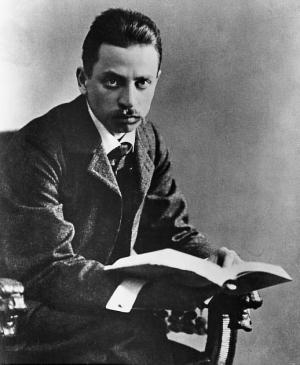
Rilke - the poet.

Close - the painter.
I was reading a book called Wisdom which featured interviews with prominent cultural icons and Chuck Close was one of them.
I agreed with two statements of his and have since taken them to heart: he mentioned he wouldn't create if he didn't have an audience, and that you can't rely on inspiration in order to create since it's based on discipline and devotion.
The former statement goes against what a lot of people base their ideology around - how they would create even if no one was around to see their work, how it doesn't matter if no one cares, because what matters is the fact that they're expressing themselves and working.
But I found Chuck Close's statement to be refreshing and honest - he's working (despite his paralysis) because he knows other people care about his efforts and not simply to satiate the need (if it is a need) to create for his own purposes.
Does this contrast what Rainer Maria Rilke wrote in Letters to a Young Poet? He stated that "if one feels they could live without writing, one shouldn't write at all".
I originally interpreted this to mean that if you think you could work at another profession aside from writing, you shouldn't write. This mode of thinking places a limit on an author - how they're expected only to write. Look at Sherwood Anderson or Franz Kafka, who had prominent positions as president of a manufacturing company and for a worker accident insurance company respectively.
They were working and writing. The question is if they were writing for an audience. Or maybe the bigger question is if their love for writing is what really mattered. Because that's also what Rilke could've meant. But people can enjoy something yet still live without it, and I don't think that if people write for simple expression or enjoyment that they should be deprived of it.
What Rilke may have meant is that if you're not serious about the progression of literature and write only for fame or money, then you're not writing for the proper reasons. And I would agree with him on that. But if he's saying that the only people who write should devote themselves to literature and not have the potential to become something else (even if it's something they don't have as much enthusiasm for), I disagree with that because it limits our freedoms.
Which ties into another statement by Rilke: "Don't write love poems." To which I think, "Don't tell me what to write and what not to write." Which may seem immature, like I'm going against one of my parents, but it's true. Just because the love poem can easily become bathetic, that doesn't mean it doesn't have potential. To write one and not make it trite (while retaining a high level of truth and emotion) is I think an admirable effort.
Chuck Close's statement of not letting your work be guided by inspiration also ties into Rilke's. A lot of writing is inspired by love, and rightly so. But at the same time, if I write solely because I was inspired by an attractive girl I saw and left writing alone for the rest of the time, would I really be accomplishing anything of value and demonstrating my love for the artform, or just trying to use the artform without appreciating it? I think it's perfectly alright to be inspired and to draw upon the strength from that - that's what I do on a regular basis. But I now believe that the dedication stokes the fire of the inspiration, thanks to Close's comment - a support that lacks in my life more often than not.
Monday, January 24, 2011
Friday, January 14, 2011
Sunday, December 12, 2010
André Malraux.

He looks quite a bit like Nabokov in the photo I used for this post. Maybe it's a staple of photographers to try and capture the "darkness" of a writer, staring lurching and heaving in the corner, sacrificing an animal in the middle of a dinner party. You have to be dark to write, and you have to suffer. And an artist doesn't need to study, they need to create. And to be an author you have to study the great works of literature. And to be an author you had to have been something, anything beforehand (do all the past jobs I've had count?). And so many other stipulations - are they in the best interests of aspiring authors or are they blockades to try and preserve the market?
Malraux once stated "Art is the rebellion against man's fate." This has stuck in my mind due to its implications. On first glance I thought it mirrored artistic rebellion against political oppression, but then it seemed like it spread deeper into how an artist wants to change the past and form the future, to escape their the people in their lives. Just come face to face with what's disturbing you and try to change it. Like the recent scandal at York University where I study - how could someone who was a university professor, married, and described as being an outgoing positive person also be into child pornography?
On the subject of Malraux, I believe those interpretations I listed are all dependent on whether or not the idea of fate is to be believed. Personally I don't believe in fate - I believe existence is to be lived in the best way we can try to live it. That sounds like the whimsy of youth but it should be upheld. Fate is reminiscent of the Calvinist doctrine's idea of absolute predestination, which states that certain people have been selected by God to go to Heaven and some haven't. This type of selective thinking is unnecessary but people buy into it. I apologize if you're a Calvinist and reading this, but no one should blindly follow any religion without questioning it and placing it in the greater context of their lives. Neither should anyone believe that their religion is better than others, or force their beliefs on other people.
It could be argued that fate is a method of classification, and in many instances classification is a form of control. A society where a domineering train of thought is to control other people isn't what I have in mind when I think of the place I'd like to spend my days. These days I'd rather be in a Bohemian atmosphere, where people want to go out on adventures where the people are friendly and mature and considerate, the architecture's nice and the air's always fresh, and she's there. You can write that off as being trite and unrealistic, caught in a flailing North American dreamscape, but it holds a lot of promise for me. To get older and say to myself "I just kinda go with the flow" isn't what I would commit to.
Tuesday, November 23, 2010
The White Flash.
Today I heard that if you meet an author you should avoid them, because they'll eventually write about you and it most likely won't be a positive depiction.
It's funny how I heard this at a time when I've been trying to create more exposure and sent out a story to a writer's group recently which could be seen as based around someone I've met in real life. It's funny because, well...I've found all the negativity that comes up in writing nowadays is numbing to the point of grim humour, but it's more depressing than anything because this is another misconception about myself and my life that I have to defend myself against. I would never meet someone then commence to write a story entirely based around them, or provide a description of them. I've never based my work around creating a mirror for someone I've met, to reveal "what they're about" to the public, to categorize them.
On this website I've written the very rare true anecdote that includes people I know in real life. I was never fully comfortable with it so I've gotten rid of them. It's inevitable that a creation is going to draw upon someone the artist has met no matter if they're successful or not. But I'm not a hypocrite and I don't want to seem like one, so I've learned from what I've heard today. But what I've heard today doesn't fit me into a mould by any means either.
I might get inspired by people I know, but I would never write about them as I know them. There's never been any fictional character in any of my writing that I've designed around people I've known, and that's the truth. No characters in Disssociation or my poems or short stories are depictions of people I've known. Pentimenti is an exception - it's based around someone I know but it's solely out of respect. They're manifestations of my own thoughts. I wrote some poems for girls before, and I shared them with said girls before showing them to anyone else. That's it. I've had a story written about me, and I was uncomfortable with my depiction as well. I haven't spoken to the author in a long time because I couldn't handle the issue. I understand the problems it creates.
But the hard fact of the matter is that people might not believe me. But that's alright - I've told people before that I wouldn't base anything I write on their own lives. No one can trace any of the characters I wrote to anyone in real life, because they're wholly fictional.
There's nothing else I can say about this matter. As I've stated earlier it's just another misconception in writing that I have to bear the brunt of. So please don't avoid me.
But I shouldn't overthink it. And now for the good music.
It's funny how I heard this at a time when I've been trying to create more exposure and sent out a story to a writer's group recently which could be seen as based around someone I've met in real life. It's funny because, well...I've found all the negativity that comes up in writing nowadays is numbing to the point of grim humour, but it's more depressing than anything because this is another misconception about myself and my life that I have to defend myself against. I would never meet someone then commence to write a story entirely based around them, or provide a description of them. I've never based my work around creating a mirror for someone I've met, to reveal "what they're about" to the public, to categorize them.
On this website I've written the very rare true anecdote that includes people I know in real life. I was never fully comfortable with it so I've gotten rid of them. It's inevitable that a creation is going to draw upon someone the artist has met no matter if they're successful or not. But I'm not a hypocrite and I don't want to seem like one, so I've learned from what I've heard today. But what I've heard today doesn't fit me into a mould by any means either.
I might get inspired by people I know, but I would never write about them as I know them. There's never been any fictional character in any of my writing that I've designed around people I've known, and that's the truth. No characters in Disssociation or my poems or short stories are depictions of people I've known. Pentimenti is an exception - it's based around someone I know but it's solely out of respect. They're manifestations of my own thoughts. I wrote some poems for girls before, and I shared them with said girls before showing them to anyone else. That's it. I've had a story written about me, and I was uncomfortable with my depiction as well. I haven't spoken to the author in a long time because I couldn't handle the issue. I understand the problems it creates.
But the hard fact of the matter is that people might not believe me. But that's alright - I've told people before that I wouldn't base anything I write on their own lives. No one can trace any of the characters I wrote to anyone in real life, because they're wholly fictional.
There's nothing else I can say about this matter. As I've stated earlier it's just another misconception in writing that I have to bear the brunt of. So please don't avoid me.
But I shouldn't overthink it. And now for the good music.
Subscribe to:
Posts (Atom)