Saturday, February 12, 2011

"Nothing's Sacred"


"You're an artist Clifford, it's your job to give offense." - Jennifer Wallace, character from Martin Crimp's The Treatment.

And that's the bottom line...I try to rebel against that idea. It's not impossible to write literature that doesn't offend yet still challenges and stimulates an audience.

When looking at comedy for example, even though it can't be taken seriously (no matter how much the comedian tries to assert that they're making a dire statement), there's comedy that directly offends other people (for example Don Rickles) and comedy that doesn't attempt to provoke and offend and is just as popular without becoming pablum (for example Mitch Hedberg RIP).

If this is true of one "artform" then it should be true of all of them. If comedy can hold this dichotomy, then so should literature, painting, et al..

To write and challenge without offending is a non-conformist idea to me. What I hold valuable in writing is the concept of appealing to audiences without creating unnecessary offense or barriers between people. I don't try to write wild claims in my work that I can't back up solidly just to get attention.

This is one of my golden rules when trying to create effective literature, whether it's successful or not time will tell. But then there are other maxims for success (in a lot of the business world, at least) which have translated sucessfully into art that I have trouble with...

...for example, "sex sells" and "anxiety sells", with the former being more well-known. To incorporate both ideologies into art - but in a manner that creates inspiration and knowledge rather than insecurity - isn't an implausible direction for me to work towards.

The "sex sells" attitude is detrimental in my mind to progression as an author. I have nothing against sex itself, no hesitation, disgust, perversions, dismissal. A lot of people say they have no issues with sexuality, but they still harbour discomfort surrounding it. I'm heterosexual but I believe in rights for homosexuals and women. I wish sex was a part of my everyday life to tell the truth, and that's not because of the fact that I'm twenty-five either. To me it's integral to health and to relationships...but it seems to me that sexuality has been tarnished by an overabundance of media regarding it, as well as it sinking so quickly into humour. Its meaning can become dulled as a result.

I don't take sexuality completely seriously (as should be the case), but I think its power, importance and its complexity is diminished by an unceasing flux of media content which exists mainly to generate profits. It's common sense that too much of anything doesn't result in positivity. Yet since it's an integral part of life (as should be the case) it needs to have a place in art. What sort of place it has, and should have, in today's society needs to be taken into deep consideration by artists.

"Anxiety sells" when it comes to aging, comfort in your home, countless other issues...the problems that could arise or be there already, but you don't know, but buy this product just in case they happen, or buy this product to save time because time is money...
...and it's easy to get caught up in this. I recently bought tea tree oil for my hair because I'm worried about losing it from stress, and I think it's healthy to use. Will it work? Time will tell. Are natural health products a huge goldmine which all stem from fostering anxiety? Does just thinking you have a problem lead to you having an actual problem? Paranoia should never be the only sane state of mind...it shouldn't exist at all. No one told me or suggested that I'm losing my hair, or to buy tea tree oil - it was all by my own volition. And I'm not saying that health and beauty products are unnecessary, they can definitely be beneficial. Only in cases where a business will convince people that their lives are lacking without certain products, and trying to foster instability and a sense of self-loathing which can be cured by buying their merchandise, pressuring people to consume and not allowing them freedom of choice is what's repulsive.

I haven't separated myself from regular consumer choices. I choose not to purchase certain products, yet I still own pairs of Nike shoes, I still wear clothes with logos, and it's rare but I'll go to malls if I need something like electronics or dress shoes. I don't see doing so as being tricked into supporting devilish industries. But I still try to stay aware of what I buy and what shops and industies I support because it's incumbent on me as an educated member of society. Most advertising depresses me and I choose to ignore it, for example the ad which starts this post and promotes violence against women. But when I saw the ad pictured below for the first time, it gave me some hope for the future of the advertisement industry.


There are people who would completely do away with the ideas that sex and anxiety sell and strive to create meaningful art without their backing. If this has been attempted and it works (outside of children's literature that is), then I'd applaud the author who managed it...

...and simultaneously ask the question, did they do so just to be different from everyone else to try and achieve attention that way, or did they have a genuine interest in subverting creative norms?

And is the attention they might receive a result of the public as a whole becoming sick of how much sexual content and anxiety are inundating society, or would it be based on the right timing, a welcome change of pace that opens people's eyes before they inevitably close, to go to sleep once again?

Wednesday, January 26, 2011

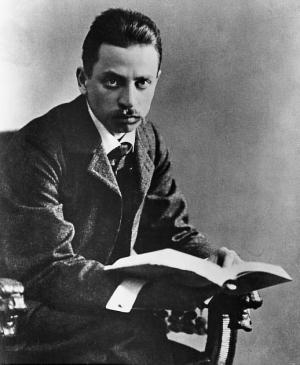
The Words of Chuck Close and Rainer Maria Rilke.


Rilke - the poet.


Close - the painter.

I was reading a book called Wisdom which featured interviews with prominent cultural icons and Chuck Close was one of them.

I agreed with two statements of his and have since taken them to heart: he mentioned he wouldn't create if he didn't have an audience, and that you can't rely on inspiration in order to create since it's based on discipline and devotion.

The former statement goes against what a lot of people base their ideology around - how they would create even if no one was around to see their work, how it doesn't matter if no one cares, because what matters is the fact that they're expressing themselves and working.
But I found Chuck Close's statement to be refreshing and honest - he's working (despite his paralysis) because he knows other people care about his efforts and not simply to satiate the need (if it is a need) to create for his own purposes.

Does this contrast what Rainer Maria Rilke wrote in Letters to a Young Poet? He stated that "if one feels they could live without writing, one shouldn't write at all".
I originally interpreted this to mean that if you think you could work at another profession aside from writing, you shouldn't write. This mode of thinking places a limit on an author - how they're expected only to write. Look at Sherwood Anderson or Franz Kafka, who had prominent positions as president of a manufacturing company and for a worker accident insurance company respectively.

They were working and writing. The question is if they were writing for an audience. Or maybe the bigger question is if their love for writing is what really mattered. Because that's also what Rilke could've meant. But people can enjoy something yet still live without it, and I don't think that if people write for simple expression or enjoyment that they should be deprived of it.

What Rilke may have meant is that if you're not serious about the progression of literature and write only for fame or money, then you're not writing for the proper reasons. And I would agree with him on that. But if he's saying that the only people who write should devote themselves to literature and not have the potential to become something else (even if it's something they don't have as much enthusiasm for), I disagree with that because it limits our freedoms.

Which ties into another statement by Rilke: "Don't write love poems." To which I think, "Don't tell me what to write and what not to write." Which may seem immature, like I'm going against one of my parents, but it's true. Just because the love poem can easily become bathetic, that doesn't mean it doesn't have potential. To write one and not make it trite (while retaining a high level of truth and emotion) is I think an admirable effort.

Chuck Close's statement of not letting your work be guided by inspiration also ties into Rilke's. A lot of writing is inspired by love, and rightly so. But at the same time, if I write solely because I was inspired by an attractive girl I saw and left writing alone for the rest of the time, would I really be accomplishing anything of value and demonstrating my love for the artform, or just trying to use the artform without appreciating it? I think it's perfectly alright to be inspired and to draw upon the strength from that - that's what I do on a regular basis. But I now believe that the dedication stokes the fire of the inspiration, thanks to Close's comment - a support that lacks in my life more often than not.

Friday, January 14, 2011

Sunday, December 12, 2010

André Malraux.


He looks quite a bit like Nabokov in the photo I used for this post. Maybe it's a staple of photographers to try and capture the "darkness" of a writer, staring lurching and heaving in the corner, sacrificing an animal in the middle of a dinner party. You have to be dark to write, and you have to suffer. And an artist doesn't need to study, they need to create. And to be an author you have to study the great works of literature. And to be an author you had to have been something, anything beforehand (do all the past jobs I've had count?). And so many other stipulations - are they in the best interests of aspiring authors or are they blockades to try and preserve the market?

Malraux once stated "Art is the rebellion against man's fate." This has stuck in my mind due to its implications. On first glance I thought it mirrored artistic rebellion against political oppression, but then it seemed like it spread deeper into how an artist wants to change the past and form the future, to escape their the people in their lives. Just come face to face with what's disturbing you and try to change it. Like the recent scandal at York University where I study - how could someone who was a university professor, married, and described as being an outgoing positive person also be into child pornography?

On the subject of Malraux, I believe those interpretations I listed are all dependent on whether or not the idea of fate is to be believed. Personally I don't believe in fate - I believe existence is to be lived in the best way we can try to live it. That sounds like the whimsy of youth but it should be upheld. Fate is reminiscent of the Calvinist doctrine's idea of absolute predestination, which states that certain people have been selected by God to go to Heaven and some haven't. This type of selective thinking is unnecessary but people buy into it. I apologize if you're a Calvinist and reading this, but no one should blindly follow any religion without questioning it and placing it in the greater context of their lives. Neither should anyone believe that their religion is better than others, or force their beliefs on other people.

It could be argued that fate is a method of classification, and in many instances classification is a form of control. A society where a domineering train of thought is to control other people isn't what I have in mind when I think of the place I'd like to spend my days. These days I'd rather be in a Bohemian atmosphere, where people want to go out on adventures where the people are friendly and mature and considerate, the architecture's nice and the air's always fresh, and she's there. You can write that off as being trite and unrealistic, caught in a flailing North American dreamscape, but it holds a lot of promise for me. To get older and say to myself "I just kinda go with the flow" isn't what I would commit to.

Tuesday, November 23, 2010

The White Flash.

Today I heard that if you meet an author you should avoid them, because they'll eventually write about you and it most likely won't be a positive depiction.

It's funny how I heard this at a time when I've been trying to create more exposure and sent out a story to a writer's group recently which could be seen as based around someone I've met in real life. It's funny because, well...I've found all the negativity that comes up in writing nowadays is numbing to the point of grim humour, but it's more depressing than anything because this is another misconception about myself and my life that I have to defend myself against. I would never meet someone then commence to write a story entirely based around them, or provide a description of them. I've never based my work around creating a mirror for someone I've met, to reveal "what they're about" to the public, to categorize them.

On this website I've written the very rare true anecdote that includes people I know in real life. I was never fully comfortable with it so I've gotten rid of them. It's inevitable that a creation is going to draw upon someone the artist has met no matter if they're successful or not. But I'm not a hypocrite and I don't want to seem like one, so I've learned from what I've heard today. But what I've heard today doesn't fit me into a mould by any means either.

I might get inspired by people I know, but I would never write about them as I know them. There's never been any fictional character in any of my writing that I've designed around people I've known, and that's the truth. No characters in Disssociation or my poems or short stories are depictions of people I've known. Pentimenti is an exception - it's based around someone I know but it's solely out of respect. They're manifestations of my own thoughts. I wrote some poems for girls before, and I shared them with said girls before showing them to anyone else. That's it. I've had a story written about me, and I was uncomfortable with my depiction as well. I haven't spoken to the author in a long time because I couldn't handle the issue. I understand the problems it creates.

But the hard fact of the matter is that people might not believe me. But that's alright - I've told people before that I wouldn't base anything I write on their own lives. No one can trace any of the characters I wrote to anyone in real life, because they're wholly fictional.
There's nothing else I can say about this matter. As I've stated earlier it's just another misconception in writing that I have to bear the brunt of. So please don't avoid me.

But I shouldn't overthink it. And now for the good music.

Saturday, November 20, 2010

Cute and sweet.

William Faulkner stated that an author needs three things to succeed - imagination, wisdom and observation, with any two of those able to substitute for the other. The issue of substitution is reassuring for me - I've always known that imagination and observation can lead to wisdom but for Faulkner to have mentioned it provides me with a strength that allows me to diminish the stress set in by not feeling 'old enough'.

But as I've mentioned in the past I don't conform to the stereotype of the author wherein we're considered to be lurking in the shadows, trying to listen in on people. I think that's what people have in mind. But that's not what observation is. It's not found by going out and looking for something weird that people are doing. It's a very sad image to me, an aspiring author furiously scribbling notes in their small notebook as some bizarre event is unfolding in front of them on the street. I don't believe that observation is genuine if you go out looking for it; it's genuine when you come across something by chance, and it remains in your memory. I believe that's one of the keys for an author to have - a strong memory.

But a strong memory isn't always fortunate, especially when I've been exposed to something disturbing. Then it's a struggle not to think and to move on from what I've seen. For too long I've had to deal with rejection, relying on my own self to combat whatever ugliness comes around. It brings to mind the struggle between 'thinking' and 'feeling', basic as that sounds. Don't think, just feel. Don't concern yourself with the ramifications.

Thursday, November 4, 2010

Weltanschauung.

The definition of a weltanschauung is "world view", or your complete set of views that comprise your understanding of the world.

It's a lush word (another being boustrophedon which means numerous lines written from right to left and vice versa), one of many that define my enjoyment of language. They say the more words you learn and absorb into your active vocabulary, the lesser your chances of growing senile.

But what I'm trying to accomplish with this title is the fact that the world view of many people doesn't include an innate sense of health. So many people pine for good health - and it's there for you to achieve. That's the problem - the answer is there and can be realized.
I don't smoke, I rarely drink coffee, I rarely eat fast food and think its domineering presence in North American society is ridiculous, I scrutinize my saturated/trans fat and cholesterol intake, I watch my sugar/salt intake, and I don't do drugs (I drink occasionally but I'm weaning myself off of it gradually). I don't judge people if they do partake in any of this. I exercise; I take care of my body. And I don't have anyone to motivate me - it all happens by my own resolve.

Is that a problem? Do I not fit into the traditional role of an author by maintaining this level of self-respect?


What happens if I post this photo of a protein/vitamin supplement powder - Bodyflex AM - which I think is excellent and use on a regular basis? Maybe a real artist isn't supposed to endorse any product, and in doing so becomes a sellout. Maybe, since the devil is much more appealing than God, my strength as an author is diminished.
It has always been numbing to me - how there should be a measure of self-destruction embedded in an artist for their work to gain recognition. Maybe that's just a role people buy into. The role that my peers all over the world buy into because this is the time period in which they're supposed to do what I aspire to do for a living - write. The mid-twenties ennui that creates countless drunken poems and stories, ideas which never came about because they weren't supposed to. It makes me laugh, how ever since I was a child I wanted to write - and now that I'm in my twenties and writing, I'm only seen as fitting into a mould that's expected of my age range.

But I don't laugh too hard or too long. I never fell to the bottom of the hole of self-destruction. I'm focused on self-development. Whether or not this is going to become detrimental for my future, I'll have yet to see.

Sunday, October 24, 2010

Wednesday, October 20, 2010

David Foster Wallace.


I first heard about David Foster Wallace in 2008 in a university class for grammar. The professor handed us an essay written by Wallace on SWE (Standard Written English). The very next week, our professor told us David Foster Wallace had committed suicide. I still remember how he said it...not to talk badly about my former professor, but he was very matter-of-fact and almost amused by the news of Wallace's death.

The fact that he's more popular after his death is something I'll overlook in this post. This video is important to me based on how he, an author of talent and stature and intelligence, doesn't put a lot of stock in publicity and making appearances.

The reclusive, hidden author who's always out of the public eye, creating his or her latest masterpiece...does this maintain the traditional legend of the subversive, effective author? Fitting into old, respected romantic roles... .

I can understand his discomfort with reading his work aloud - I personally can't decide on what sections of Disassociation to read aloud because every paragraph falls under a greater context and reading one out of context to people who haven't read the book is always a difficult task.

He expresses ennui at going to bookstores and performing readings, saying how an author is relegated to a quasi-celebrity as a result. And I can understand how it would be stiff and impersonal to read passages from a book people have already read, not caring about the content and just wanting to see the creator and how he or she sounds.
But I don't see the discomfort on his level. Maybe it's a less intelligent level. I wouldn't have a problem going to read my already-read work to audiences. I say 'already-read' because whenever I do readings I know the work I read hasn't been read by anyone in the audience before. But I don't see anything wrong with giving audiences...admirers...maybe even fanatics...? a taste of how I look, and how I read. Maybe I wouldn't even read from the work I'd be promoting. I could write entirely new poems and stories and weave the novel/collection I promote into the contents somehow...neglecting my commercial publishers' intents in a middle finger to corporate agendas...
...when you go to a concert and the band plays a different version of the song, are you excited or disappointed? Similarly, if I go to read a passage from the book I'm promoting but put a new spin on it (somehow, without sacrificing the strength of the rest of the book), would that be enjoyable or just confusing and unappealing?

Throughout all of this speculation, I don't have a fame complex, I can live without ever gaining mass fame. I believe fame is a byproduct of creating meaningful works of art, and not the means to the end. It's the same with money...but the argument against this should be a separate post.
To give an audience what they want is completely acceptable to me. After all, I don't believe the strength of my work would suffer as a result. It's a lesson to learn, how writing is really a social act instead of the private suffering act we're pushed to believe in. But there's nothing wrong with subverting the expected... .

Fields.


But throughout all the negativity... how this isn't something an author of any merit would undertake, how it's considered juvenile and commercialized in the...

...Well, why overthink it. I should just allow it to mean what I want it to mean. It's just fun and challenging. This was the biggest drop-in I've ever done. It was at the Winnipeg park at the Forks. I was trembling after I did it for the first time, which was on a previous morning and not filmed. It was an overbearing mental boundary that I overcame by myself, as with most problems in my life.

I rolled away clean the first time I did it. This time I rode over the bump in the middle and fell, but it doesn't really matter. In retrospect it's only a stepping stone for me to start skating vert the way I want to - because I did this, now I can drop in on the vert at the Vanderhooft park, and after that the 10-foot vert ramp at the CJ park, and then the 11-foot extension there as well...and that'll be the beginning of a new beginning.

It's an activity I enjoy - not a lifestyle (although I can't stand the way it's portrayed in mainstream media, MSM), not a hobby, not a closet full of skeletons or a cross to bear.

Friday, October 1, 2010

"Everybody needs a hobby."

I always feel depressed and angry whenever the overwhelming feeling of being used happens - even in this website, sometimes it feels like it's just a tool for my thoughts and discussion to be copied/used in order for people to further their own literary ambitions (because so many want to write a bestselling novel strictly to become rich and famous). This is not a statement made from lack of recognition/fame, it's made from the pitfalls I've been exposed to throughout my life. Can you imagine what kind of life it would be just to exist as a forgotten benchmark, never to reap the full benefits of your efforts and morals?

And this relates to the domineering encumbrance I have to try and forget whenever I write - the idea of authority. How writing is nothing more than a method to exert authority over objects, other people, anything. How people just use writing to classify others, to drive them in a corner and prepackage them in method of storytelling to try and appeal to the public's sense of stereotype and therefore sense of control. Gore Vidal was once quoted as saying "I want to destroy younger authors." All the competition and nonstop classification, scrambling to get the upper hand all the time. No wonder a lot of established authors are reclusive - all they wanted is to forge their own path and write the best literature they could, not to be exposed to people clawing at their heels and trying to undermine them, most likely starting from when they were young and continuing to their current age.

This is only one part of the overall stress that I have to fend off every day. But I should make it clear that I'm very well aware this can be seen as expressing my frustrations, which Virginia Woolf would warn against as I've mentioned in the past, or bordering on "singing my distress" as André Breton wrote...
...but it's still necessary. And I know why.